
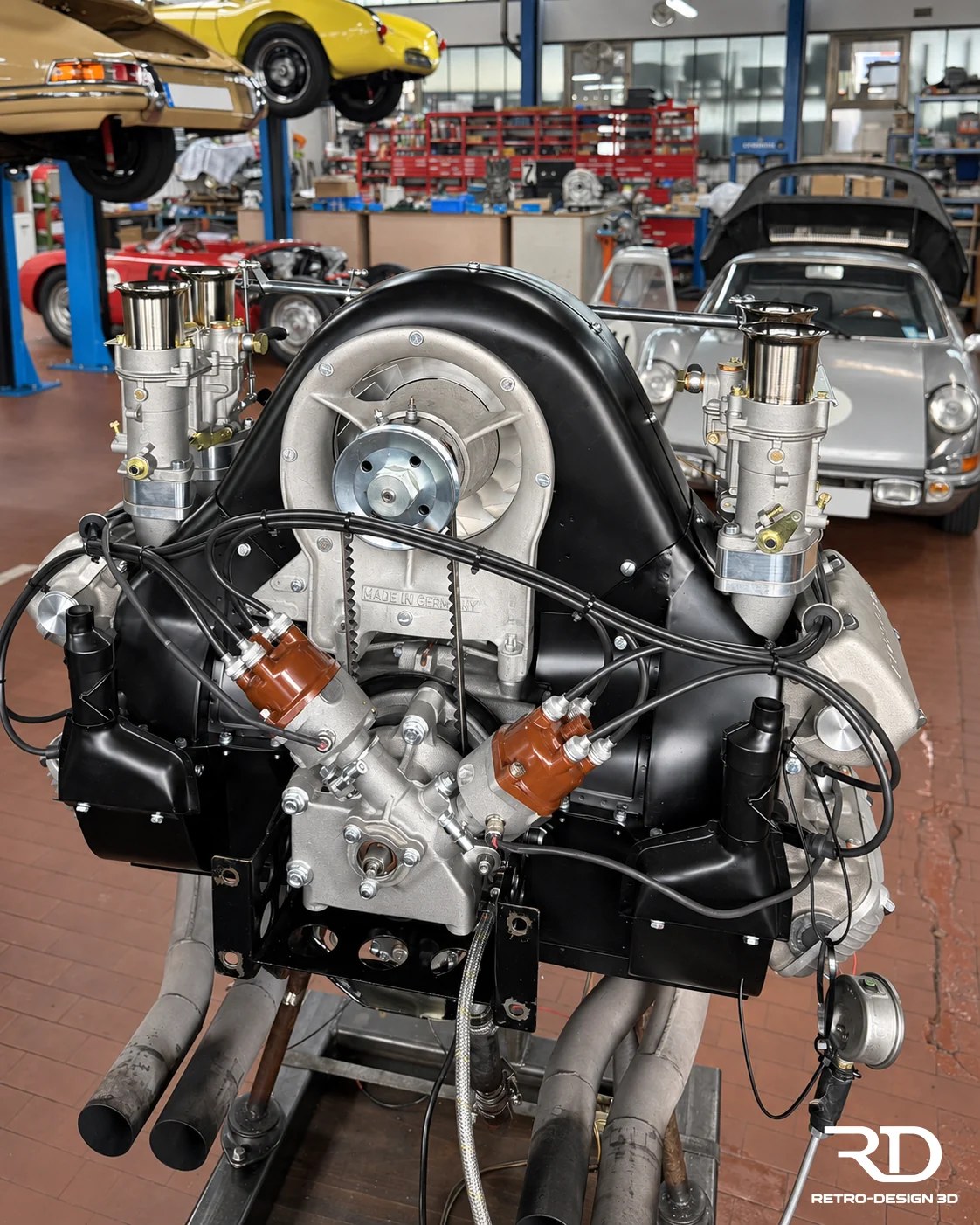
Several names for the same engine concept
The historic Porsche four-cam engine is a four-cylinder boxer engine with two overhead camshafts per cylinder bank. “Four-cam” or “4-Cam” describes those four camshafts. The name Fuhrmann engine refers to its designer, Ernst Fuhrmann. Type 547 and the related types 692 and 587 belong to this engine family.
When searching for parts, you will also encounter the German names Königswellenmotor and Fuhrmannmotor, as well as the spelling 4cam. These terms help you navigate the subject, but they do not replace a precise engine or part identification. Similar names do not establish matching component specifications.
What the bevel-drive shafts do
The shafts transmit rotation through angular gear drives to the camshaft drive. Conical gears redirect rotation between shafts whose axes point in different directions. This is why the associated gears and bearings, as well as the shafts themselves, need to be considered when identifying drive components.
Our catalogue lists shafts, pinions, crown wheels and bearings separately. Tell us whether you need an individual replacement or a matched pair, and record the markings on the mating component too. A part’s position on the engine helps you find it; that position alone is not an assembly or adjustment instruction.
The four-stroke cycle, briefly explained
Intake, compression, power and exhaust form the working cycle. The fuel-air mixture enters the cylinder, is compressed by the piston and ignited by a spark. Expanding combustion gases drive the piston; the spent gases are then expelled. The connecting rod and crankshaft convert piston movement into rotation.
Four strokes describe the working cycle. Four camshafts describe the valvetrain layout. The two expressions therefore mean different things. Specific valve timing depends on the cams actually installed and their corresponding setting instructions.
547, 692 and 587: the type number is a starting point
Our parts overviews distinguish the three engine types. Some components have a documented association with more than one type; others are listed as separate versions. A shared association applies to the individual component and cannot be extended to the entire engine.
For example, our catalogue lists crankshaft timing gear 547 075 016 for the 547 roller-bearing engine separately from timing gear 587 075 014 for 692/587. Similarly, long bevel-drive shaft B 587 224 01 is a different catalogue version from B 692 224 01 for 547/692. Individual part pages provide the documented associations and selection guidance.
The engine variant, existing mating parts and previous modifications also matter. A vehicle name or production year is not enough. For a newly manufactured engine, specification, displacement, ancillaries and scope of supply are agreed for the project. Historic power figures do not automatically describe the new engine.
From the existing engine to the required component
Start with an overall engine photograph and images of legible identification marks. For the part you need, add views of its installation position, interfaces and mating components. Copy numbers in full, including letters and suffixes. Tell us which existing parts you intend to retain.
Search the catalogue by component name or part number. The visual parts finder takes you from an engine area to an assembly and then to individual components. If the engine type is uncertain, start with “All / unsure” so an early assumption does not narrow your search incorrectly.
A component, a complete engine or a replica build?
Retro-Design 3D offers reproduced engine components and newly manufactured four-cam engines. A replacement component needs to be checked against the existing parts. For a complete build, the discussion also establishes which assemblies and ancillaries are included in the agreed scope of supply.
For replicas, we also consider the chassis, transmission, engine mounting, cooling and available installation space. Describe the intended use and current stage of your project so the next technical questions can be addressed. Our engine page explains configurations and how to start an enquiry.