
The 550 Spyder and the Fuhrmann engine
Porsche describes the 550 Spyder as a mid-engined racing car with a four-cylinder boxer engine. Its historical engine concept includes the Type 547 developed by Ernst Fuhrmann, with four overhead camshafts and a bevel-shaft drive. Porsche records its use in the 550 Spyder at the 1954 Carrera Panamericana.
That history provides a useful starting point. It does not identify the specification of an individual engine: the vehicle name alone cannot establish which components are fitted today or which replacement version is required.
An existing engine, a replacement build or a replica?
For an existing engine, start with its complete identification and the markings on the part. Include known modifications and explain which components you intend to retain. An overall engine photograph and a view of the part in its installation position help with the initial review.
For a new engine build, the intended specification and the components it will connect to are central to the discussion. A replica project also requires information about the chassis, transmission, engine mounts and available space. Tell us which of these situations applies when you enquire.
Find the assembly, then the component
Our catalogue covers crankcases, cylinder heads, crankshaft and piston assemblies, bevel shafts and gears, plus oil-system, ignition and cooling components. Search directly if you know the part number. Otherwise, use the visual parts finder to work through an assembly to the individual item.
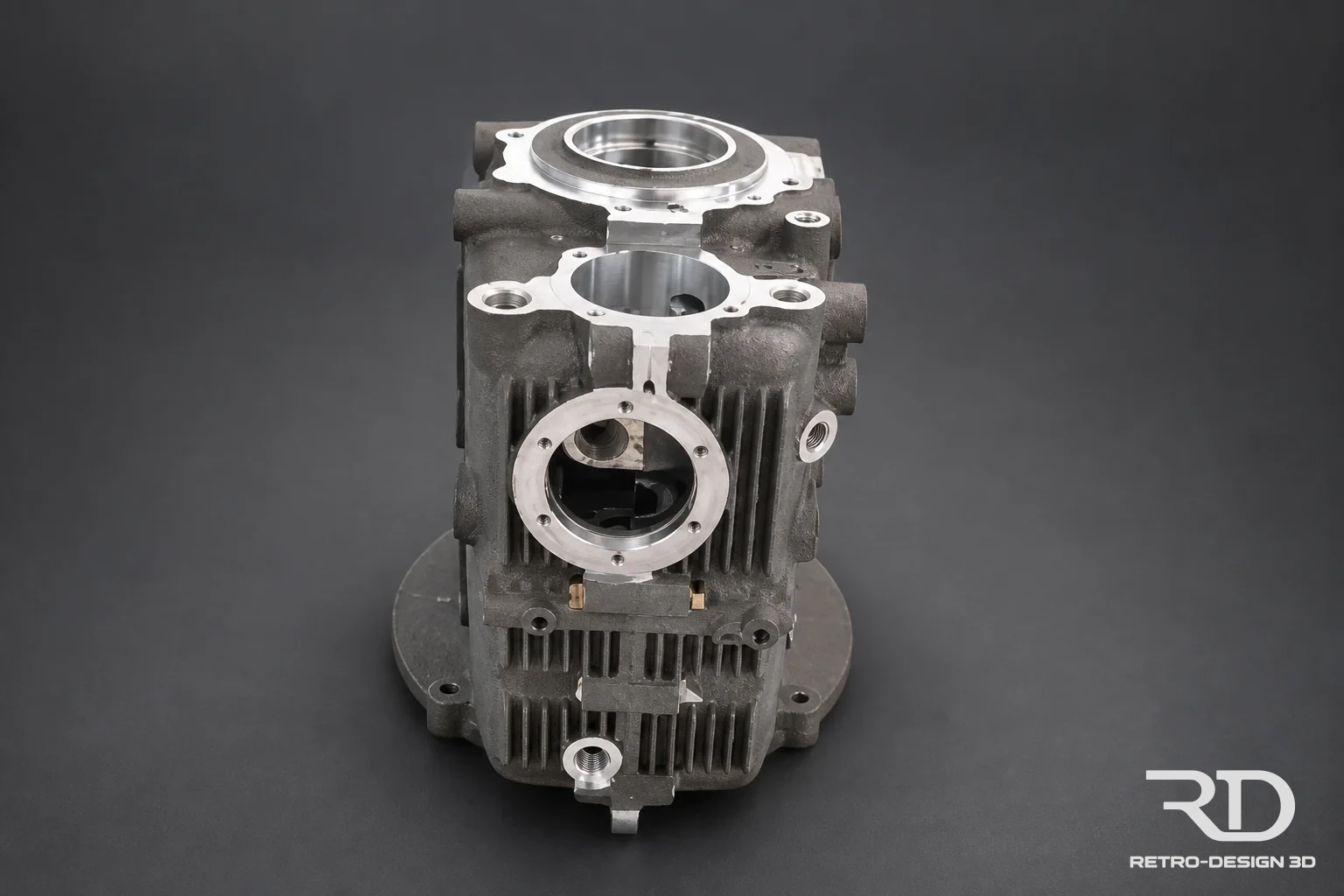
The RD-001 cylinder head and RD-004 crankcase are examples listed for Type 547. They are catalogue references for technical discussion, not a blanket fitment statement for every 550 Spyder. Other components may be listed for more than one engine type; those associations apply to the individual part.
A similar shape does not establish the specification
One example from our programme is crankshaft timing gear 547 075 016 for the 547 roller-bearing engine. It is listed separately from timing gear 587 075 014 for 692/587. The complete markings, crankshaft mounting and associated intermediate shaft are therefore part of the identification process.
Include the mounting faces and mating components in your enquiry. A similar catalogue image or the shared term “four-cam” is not enough to select a part. We discuss the specification and scope of supply for your engine before an enquiry becomes an order.
An individual part or a complete engine?
For a missing component, state the quantity and whether you need the individual part or a wider assembly. For a complete build, we discuss the engine configuration and required ancillaries. Historical 550 Spyder performance figures are not a performance specification for a newly manufactured engine.
Prepare your parts enquiry
Send the engine identification you have, the required part name or number, and photographs of the component, its connections and installation position. Include the vehicle or replica project, known modifications and the parts you plan to retain. If some information is missing, start by describing the current condition.
We reply within two business days to discuss the next steps. Prices, lead times and the technical scope of supply are agreed for the individual enquiry. A catalogue photograph does not confirm that the component is available from stock.